
Survey Insights
Explore what cybersecurity students told us about careers, certifications, and obstacles in today’s job market. The survey revealed that most students are highly interested in practical cybersecurity roles such as ethical hacking, penetration testing, and digital forensics. They are drawn to fields where they can directly apply technical skills in real-world scenarios.
Many students expressed that they feel overwhelmed by the number of cybersecurity pathways, tools, and specialisations, highlighting a clear need for structured guidance on where to start and which skills are most important. Students are also unsure about which certifications are necessary to enter the cybersecurity job market. While they recognise that certifications can be valuable, many are concerned about their cost and relevance to their chosen career path.
Another common insight is the gap between theoretical knowledge gained in university modules and the practical experience required by employers. Students indicated that hands-on labs, projects, and real-world simulations would help them feel more job-ready.
The survey also showed that a significant number of students are uncertain about which specialisation suits them, whether it is technical, investigative, cloud-focused, or policy/management oriented. They expressed a need for clear roadmaps showing the progression from academic modules to graduate roles.
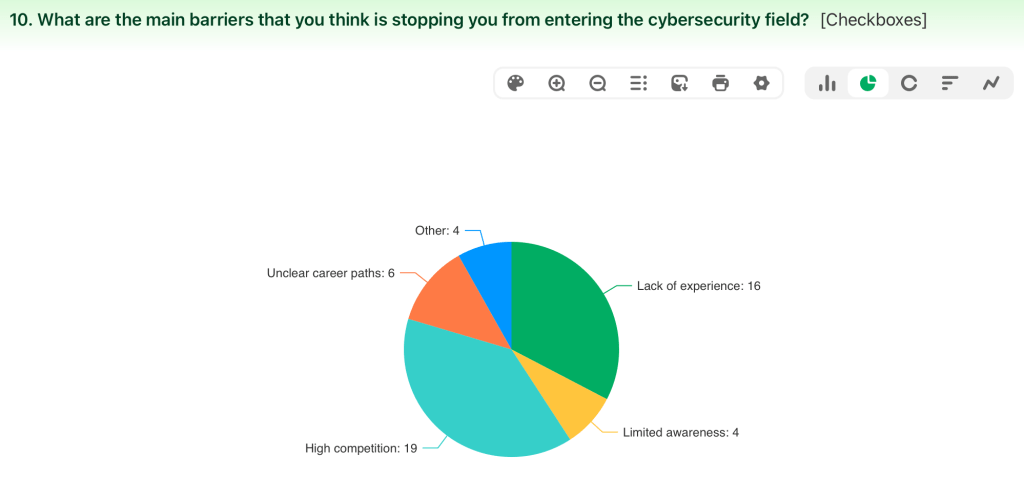
Finally, students reported feeling underprepared and lacking confidence when considering applications for cybersecurity jobs. Many suggested that mentorship, structured learning paths, and practical experience could help overcome these barriers.
Overview
Our survey of Kingston University cybersecurity students maps common career goals, key certifications, and hiring barriers, using anonymous questionnaires and follow‑up interviews to turn real student experiences into clear, data‑driven guidance. The survey was conducted to understand the interests, knowledge, and challenges of students pursuing careers in cybersecurity. It collected responses from 3rd-year students and recent graduates, focusing on their preferred career pathways, familiarity with practical skills and tools, and attitudes toward certifications. The survey also explored perceived gaps between academic learning and industry expectations, as well as the confidence levels of students in applying for cybersecurity roles. The insights gained help identify which career paths are most popular, where students need guidance, and how educational resources can better support their transition into the cybersecurity job market.



Analysis
Read in‑depth breakdowns turning survey data into career strategies. The analysis of the survey results highlights several key trends in how students approach careers in cybersecurity. Firstly, there is a strong interest in technical and hands-on roles, particularly in areas such as ethical hacking and digital forensics. This indicates that students are motivated by practical work and real-world application of skills.
However, the data also shows that many students lack clear direction when choosing a career path. The wide range of specialisations within cybersecurity creates confusion, making it difficult for students to decide which skills and knowledge to prioritise.
 Cybersecurity Career Pathways Hub